
Kevin Green
Sr. Markets CorrespondentWhat Could Influence Natural Gas This Winter?
Kevin Green
Sr. Markets CorrespondentNatural gas, one of the more volatile traded commodities, has spent the last several months consolidating as the U.S. moved through injection season, when gas is put into storage.
Over the next couple of weeks, the market will transition into withdrawal season, when gas is drawn out of inventory to generate electricity, heat homes, and meet other utility needs.
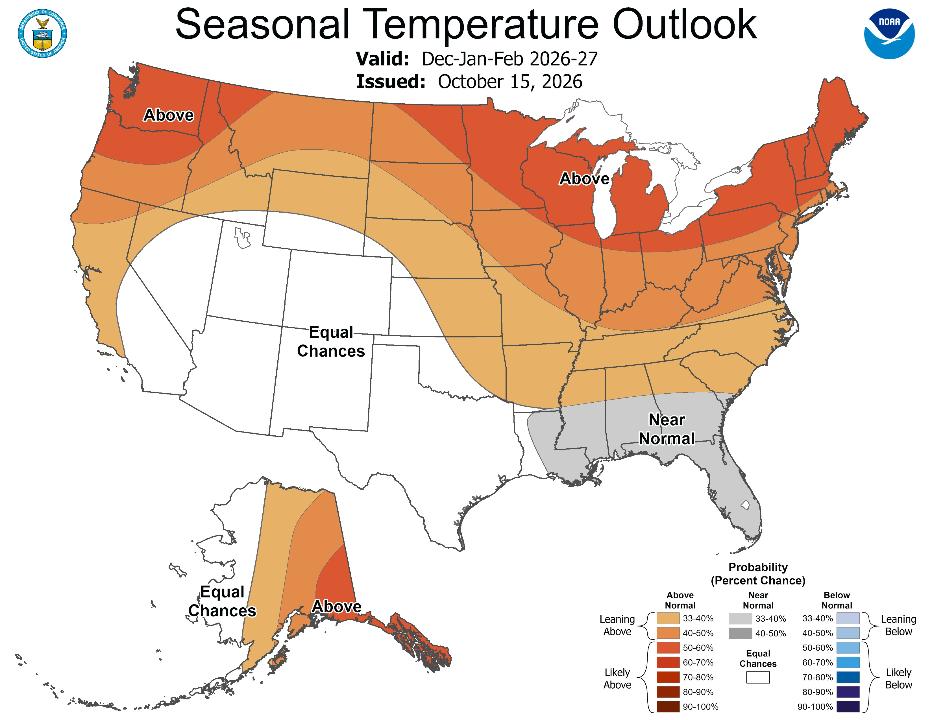
This winter could be unusual. A super El Niño has altered weather patterns and shifted storm tracks considerably. The National Oceanic and Atmospheric Administration (NOAA) released its U.S. Winter Outlook on October 15. It calls for warmer-than-average temperatures across the northern U.S. and wetter-than-average conditions across the southern tier, from California to Florida and up the Eastern Seaboard. That moisture could ease drought conditions and provide a tailwind for crop producers, but warmer temperatures pose a challenge for heating demand, and that has already weighed on natural gas futures (/NG). The added rain and snow may also be brief in some areas, and where soil is dry, it could trigger destructive flash floods and mudslides. Taken together, the outlook could be bearish for natural gas prices if these conditions materialize.
Positioning also reflects that view. According to the Commitments of Traders (COT) report, published by the U.S. Commodity Futures Trading Commission (CFTC), managed money remains significantly net short, meaning hedge funds and other money managers are positioned for lower prices. Managed money’s net position, which takes long contracts minus short contracts, is negative, and sits at roughly -144,000 contracts. That is approaching the October 2024 low of -146,937 contracts. The December Henry Hub natural gas contract is currently trading at $3.164 per million British thermal units (BTUs).
That comparison is worth noting. From October 2024 to January 2025, natural gas prices rose nearly 100% due to unpredictable weather and short covering by managed money. This makes for an interesting setup heading into winter. If a significant weather event such as an Arctic blast or a hard freeze hits the northern U.S., the short positioning could contribute to price volatility if traders adjust positions quickly.
Potential upside catalysts over the coming months are not limited to U.S. weather. European Union gas storage is only about 74% full, well below its pre-winter target. That could keep European prices elevated and support robust demand for liquefied natural gas (LNG). Strong demand for U.S. LNG, in turn, adds another draw on Henry Hub natural gas, since it serves as the feedstock for U.S. LNG exports. Geopolitical risk is also a factor. LNG tankers operating in and around the Middle East may be at greater risk due to geopolitical tension in the region and LNG tankers are already in short supply globally, creating a potential supply disruption.
Natural gas rarely gets the spotlight except in winter months when there is higher implied and realized volatility and significant position adjustments by managed money. For now, bearish fundamentals may continue to weigh on the product.
Also see the Week in Review: Oil Up, Rates and Tech Lower as Volatility Rises and this week's earnings and economic calendars in the Week Ahead: Can Corporate Earnings Offset Inflation Risk?
Featured Clips
CRWV Rebound Pulls Bulls Back to AI Trade; META, TSLA & SPCX Earnings This Week
Morning Movers
► Play video$7 Diesel Likely: Global Tensions, Winter Months Make Energy Risks More Widespread
Trading 360
► Play videoDisconnect Forms Between Earnings & Stocks; 'Conflicting Narratives' in AI & Yields
Morning Trade Live
► Play video