Expert Insights
Commentary and clips about what's moving the markets - stocks, options, economic data, futures, cryptocurrencies, and more

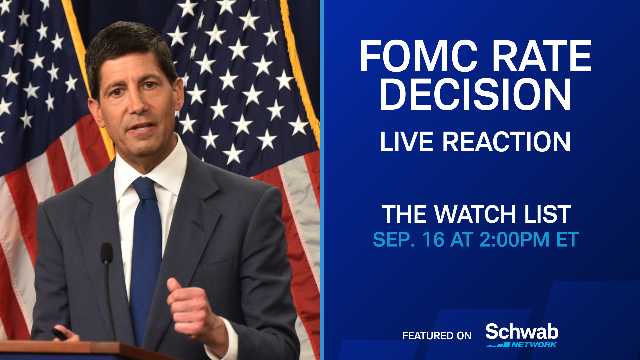
U.S. stocks tumbled on Wednesday after the Federal Reserve unanimously raised interest rates for the first time in more than three years, with Chairman Kevin Warsh flagging further tightening in store to combat persistent inflation.
The S&P 500 (/SPX) fell 0.45%, and the Dow Jones Industrial Average ($DJI) tumbled 1.21%. The tech-heavy Nasdaq-100 (/NDX) was flat, and the Russell 2000 (/RUT) fell 0.4%. The yield on the 10-year Treasury note rose to 5.006%, a slight retreat after hitting its highest level since 2007 on Tuesday.
Retail Sales jumped 1.2% month-over-month in August, beating economist expectations for 0.8%. This sharp acceleration signals consumer resilience, though Warsh was dismissive of individual economic data points Wednesday.
Energy turned in the worst S&P 500 sector performance, down 3%, as oil prices declined. The financial sector was the second-worst performer with a 1.6% slide, with banks now facing higher interest costs. The Information Technology and Health Care sectors managed small gains.
A few things to ponder from Wednesday’s market activity:
Warsh Signals More Tightening, Addresses Energy Inflation
The Federal Open Market Committee raised the federal funds rate by 25 basis points to 3.75%–4.00% in a unanimous 12-0 vote, its first hike since July 2023. Chairman Warsh told reporters that summer inflation data does not show the underlying trend improving and said he would "not prejudge any future decisions." The FOMC median dot-plot forecast signals an additional hike later this year, which would push the target rate range to 4.00%–4.25%. The median dot-plot forecast signals one more hike this year. The central bank does not expect to reach its 2% inflation target until 2029.
Asked about the Strait of Hormuz, and energy price inflation, Warsh said the Fed would work to assure there are not “second- and third-order effects.” Read Live Updates: Fed Interest Rate Decision and see John Lonski on 'Unfazed' U.S. Consumer Behind Fed's Interest Rate Hike
Oil Retreats but Middle East Risk Persists
U.S. benchmark crude oil fell roughly 3.5% to about $102 per barrel Wednesday after Saudi Arabia signaled efforts to restore flows through its East-West pipeline, which was damaged by a drone attack last week. The pullback offered temporary relief, but loadings at Saudi Arabia's Red Sea port of Yanbu remain suspended and Libya reported oil field shut downs, according to reports.
The biggest gainers in the SPX: Lumentum Holdings Inc. (LITE) (+9.59%), Coherent Corp. (COHR) (+6.91%), Axon Enterprise, Inc. (AXON) (+5.96%), GE Vernova Inc. (GEV) (+4.87%), Edwards Lifesciences Corp. (EW) (+4.13%), Intel Corp. (INTC) (+4.08%), and Revvity, Inc. (RVTY) (+3.95%)
The biggest losers in the SPX: J.B. Hunt Transport Services, Inc. (JBHT) (-13.30%), ON Semiconductor Corp. (ON) (-9.02%), Diamondback Energy, Inc. (FANG) (-8.03%), Occidental Petroleum Corp. (OXY) (-6.52%), Texas Pacific Land Corp. (TPL) (-6.21%), ConocoPhillips (COP) (-6.15%), Expand Energy Corp. (EXE) (-5.83%), EOG Resources, Inc. (EOG) (-5.73%), Devon Energy Corp. (DVN) (-5.63%), and Huntington Bancshares Inc. (HBAN) (-5.55%).
Apple ($AAPL) shares rose 0.32% Wednesday. It said it is developing an enterprise AI server using its own chips and potentially Nvidia (NVDA) networking equipment, according to The Information. Nvidia shares rose 0.82%.
GE Vernova (GEV) shares jumped 4.79% after CEO and President Scott Strazik said at a Morgan Stanley conference that the company views the 2030–2040 decade as an even better period than the current one. According to reports, the company expects second half contract commitments to exceed its 20 GW guidance, with 50% growth in gas capacity additions by the end of 2025.
For more on the remaining economic and earnings events of the week, see Week Ahead: Fed Interest Rate Decision and Heavy Economic Data
Markets Lower After Fed Interest Rate Hike
3:18 PM ET: The S&P 500 (SPX) was down 0.81%, while the Dow Jones Industrial Average ($DJI) had slipped 1.51%, after the Fed announced an interest rate hike Wednesday afternoon. The yield on the 10-year Treasury rose to 5.006%.
Those returns come despite a decline in the U.S. benchmark oil price, with WTI down more than 3% to about $102 per barrel.
To reiterate: the Federal Open Market Committee (FOMC) announced a unanimous 25-basis-point increase in the Fed Funds rate, to between 3.75% and 4.00%, in its first hike since July of 2023. Read our closing bell article for a full summary of today's market action.