VenHub (VHUB) CEO on Scaling Autonomous Convenience Stores

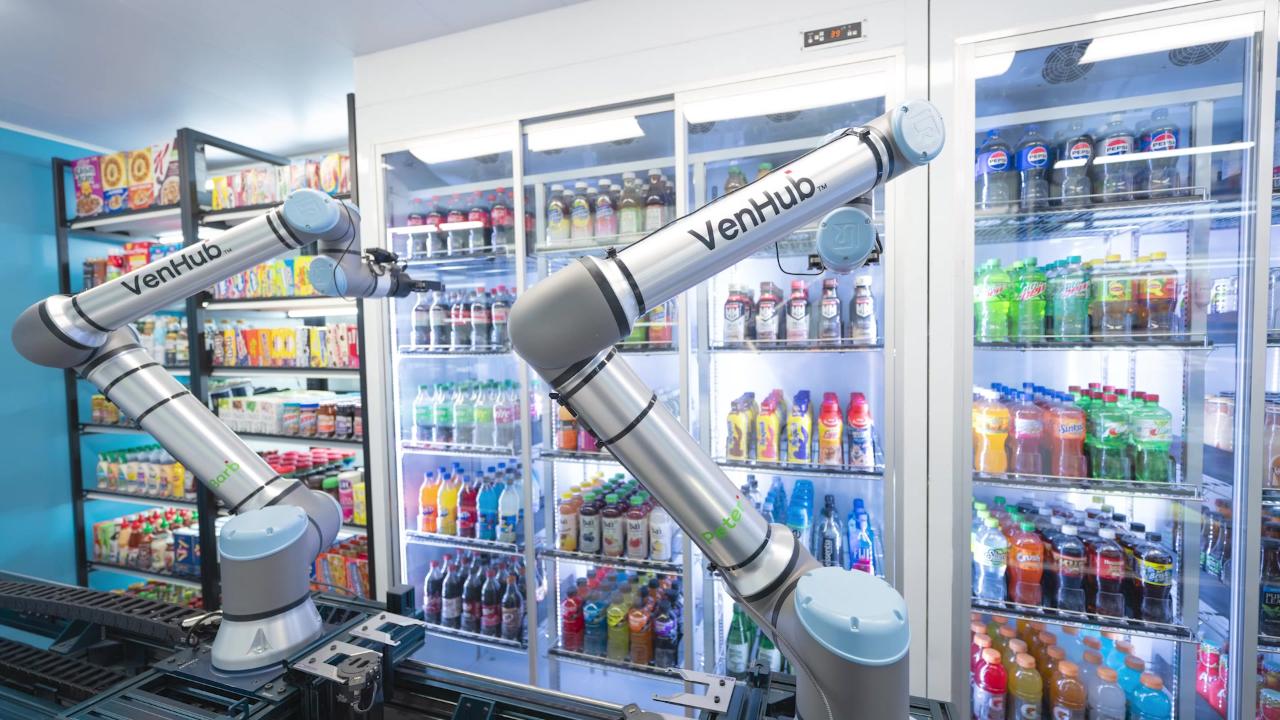
Like a cross between an Amazon Go store and a vending machine, VenHub’s (VHUB) fully robotic convenience stores offer another solution to employee-free retail. CEO and cofounder Shahan Ohanessian joined Market On Close to discuss why they went public this week and their plans for the future.
Importantly, VenHub doesn’t operate the corner stores they design. They sell them to enterprises, who are then responsible for restocking, etc. VenHub also plans to make revenue from their cloud platform and AI inventory capabilities, along with maintenance fees. They aim for locations in transit centers like Los Angeles Union Station, along with college campuses. On its website, VenHub compares its services to “traditional convenience,” estimating the cost to build at $250K-$400K vs traditional $750K-$1.5 million.
The stores, which VenHub says can be deployed within days, are steel and bulletproof glass boxes with shelves of products inside. Robotic arms collect orders made on customers’ apps and deliver them through vending machine-like doors.
VenHub also touts advanced security features and safety monitoring around the clock; Ohanessian really focused on that aspect in the interview as the stores operate 24/7. Each can offer between 300-1,600 SKUs, from food items to basic necessities to medication. VenHub anticipates $46K in annual recurring revenue per store.
People have been trying to crack fully autonomous stores for a while. Amazon (AMZN) made one of the biggest efforts with its Amazon GO stores. The main difference is those allowed customers inside and tracked purchases using an array of sensors and cameras. However, in my own experience with them, there were constantly at least two employees around to restock and assist people with using the app to enter the store, somewhat negating the whole endeavor.
Amazon discontinued its GO stores recently, citing an unprofitable business model, but notes that it has licensed its “Just Walk Out” technology to “over 360 third-party locations across five countries.” Amazon has generally had difficulties with brick-and-mortar experiments – see also their attempt at physical bookstores.
One less competitor for VenHub, then, and they recently added Ian Rasmussen, one of the people who spearheaded Just Walk Out. Primarily deployed in Southern California right now, it is trying to crack markets in major cities across North America, the Middle East, and Europe.
The stock went public through a direct listing rather than a traditional IPO. In their announcement, they noted they are in the process of acquiring over 20 technology patents, and plan to ad digital advertising panels and more packaging compatibility in the future.
Of course, its efficacy depends on a steady supply of electricity and the robotics working correctly. That’s why offloading the day-to-day ownership and operations to third parties is key; VenHub can also charge servicing fees for some issues. While it has set itself up against tampering, wear and tear may also impact some of these elaborate moving parts.
It also seems that restocking is still a human job. While machine intelligence is progressing, I’ve discussed how robotic ‘vision’ works in this column in the past, and inference still has a long way to go. Once the products are stocked, though, VenHub says its robotic arms can recognize bottle-shaped products at a 99% rate.
VenHub is still new on the scene: in its investor presentation released in September, it noted that it had four stores operating, but referenced “large pre-orders for deliveries,” citing $300M+ in potential revenue. With over 1 million convenience stores worldwide, VenHub sees a $2T end market, and they’re coming for as much of it as possible.
However, investors don’t have much information in the way of its finances because of the recent listing. In a 10-Q filed in November of 2025, the company reported revenue of $295.3K, gross margins of 25.5%, and operating margins of around -6,500%, so it still operates at a pretty substantial loss.
Volatility is common after a public offering, and the stock is still finding its footing. On its debut day, it hit a high of $40.30 but is now trading around $5. It is down around 12% in Friday’s session. VenHub has an early-mover status in automated shopping, and as hardware and megacaps see a rotation this year, names that are utilizing AI in their day-to-day business could become more popular.
Watch the full interview below:
Featured Clips
VenHub (VHUB) CEO on Fully Roboticizing Convenience Stores & Aiming for Retail Dominance
Market On Close
► Play video